
The Topic Every Parent Dreads
Allergen introduction. Even writing those words sends a flicker of anxiety through me.
As a registered dietitian, I spent years explaining allergen introduction to parents in calm, professional language. I knew the guidelines. I knew the research. I knew what to watch for and what to do.
Then it was my daughter's turn. And suddenly, sitting at my kitchen table with a small bowl of egg-yolk okayu in front of me, all that professional knowledge felt very different from the fear sitting in my chest.
I offer this as reassurance before anything else: the anxiety is normal. The science, however, is on your side. We now have strong evidence that introducing allergens early - thoughtfully, in small amounts - significantly reduces the risk of food allergy. In Japan, as in most countries, the approach to allergens has shifted from "wait and see" to "introduce early and repeatedly."
Here is what that looks like in practice.
Japan's Seven Major Allergens
Japan's Food Labeling Act designates seven foods as mandatory allergen labeling ingredients - meaning food manufacturers must declare their presence on packaging because these foods account for the vast majority of serious allergic reactions.
They are:
- Egg (卵)
- Cow's milk (乳)
- Wheat (小麦)
- Peanut (落花生)
- Buckwheat (そば)
- Shrimp (えび)
- Crab (かに)
Japan also designates a second tier of 20 recommended allergen labels - including tree nuts, fish, soy, peach, apple, sesame, and others - but the seven above are the ones that require special attention during weaning because they are responsible for the most severe reactions.
The Science Has Changed: Early Introduction Reduces Risk
For many years, the advice given to parents was to delay allergen introduction - especially for high-risk babies with eczema or family history of allergy. Wait until 12 months, some said. Wait until 3 years for peanuts.
That advice has been reversed.
The landmark LEAP study (Learning Early About Peanut Allergy), published in 2015, found that introducing peanuts to high-risk infants between 4 and 11 months reduced the risk of peanut allergy by 81% compared to avoidance. This was followed by a series of studies confirming the same principle across multiple allergens: early exposure, when the immune system is still developing, tends to promote tolerance rather than allergy.
Japan's Ministry of Health, Labour and Welfare updated its weaning guidance accordingly. The current position is clear: there is no benefit in delaying the introduction of allergenic foods in healthy infants, and early introduction is encouraged.
Japan's Ministry of Health Guidance on Allergen Introduction
Japan's weaning guidelines do not prescribe a strict order for allergen introduction. Instead, they recommend:
- Introduce allergenic foods one at a time, not on the same day
- Introduce in the morning so you can observe your baby for the rest of the day
- Start with a very small amount - a tip of a teaspoon, not a full serving
- Introduce on a day when your baby is healthy - not when they have a cold, rash, or stomach upset
- Do not introduce just before travelling or when you cannot easily access medical care
- Once introduced without reaction, continue offering regularly - tolerance is built through repeated exposure, not a single introduction
The guidelines also note that for babies with existing diagnosed eczema or a known family history of food allergy, parents should consult their pediatrician before introducing the major allergens. This is not a reason to delay - it is a reason to proceed with extra guidance.
When and How to Introduce Each Allergen
Egg (卵)
Egg is the most common cause of food allergy in Japanese infants, and the most important allergen to introduce carefully.
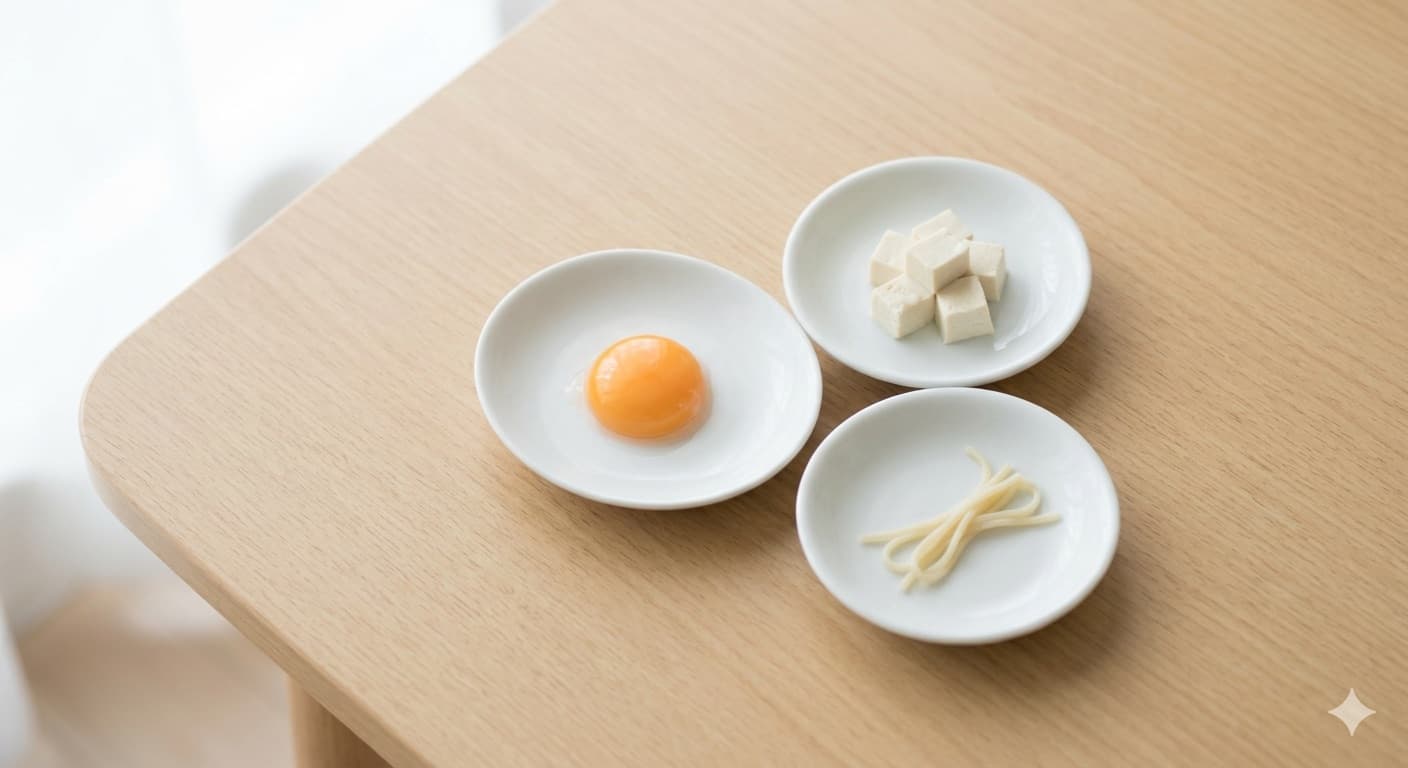
When: Stage 2 (7-8 months) How to start: Begin with well-cooked egg yolk only. The yolk is less allergenic than the egg white. Mix a very small amount - literally the tip of a baby spoon, about 1-2 grams - into okayu or vegetable puree. Progression: After several days of yolk without reaction, you can introduce well-cooked egg white in tiny amounts. Raw or runny eggs are not appropriate for babies under 12 months. Why stage 2 and not stage 1: Egg contains a protein structure that is more complex than rice or vegetables. Japan's guidelines align with most international recommendations in waiting until the digestive system has had a few months of practice before introducing egg.
Wheat (小麦)
When: Stage 2 (7-8 months) How to start: The simplest way to introduce wheat in Japan is through udon noodles - well-cooked until very soft, then finely minced or blended smooth. Udon is lower in gluten than pasta or bread and is easily accepted by babies. Progression: A few strands of well-cooked udon, blended smooth. Gradually increase texture and quantity as your baby grows. Note: Bread (pan) can also be used, but opt for plain white bread without added salt, butter, or seeds.
Soy (大豆)
Soy is one of the most beautifully positioned allergens in Japanese weaning because Japan has the perfect vehicle: tofu.
When: Stage 1-2 (from around 6-7 months) How to start: Silken tofu (絹豆腐), mashed smooth. It has a very mild flavour, a soft texture that is easy to puree, and is already a natural part of Japanese cuisine. Note: Tofu also provides good protein for babies who are not yet ready for meat or fish. It is one of my favourite Stage 1 ingredients.
Peanut (落花生)
When: Stage 2 onwards, once your baby is comfortable with a variety of other foods How to start: Pure peanut butter (unsalted, no added sugar), thinned with breast milk, formula, or water until very runny. Start with approximately 1/8 teaspoon. Important: Never give whole peanuts or chunky peanut butter to babies or young children - this is a choking hazard.
Buckwheat (そば)
Buckwheat deserves special mention in Japan because soba noodles are deeply embedded in food culture. However, buckwheat can cause severe and rapid allergic reactions, including anaphylaxis, and has one of the highest rates of serious allergy among Japanese infants relative to other allergens.
When: Stage 3-4, and only once your baby is established on a wide range of other foods How to start: A very small amount of well-cooked soba, introduced with extreme care and close observation My recommendation: This is one allergen where I genuinely encourage parents to discuss timing with their pediatrician first, particularly if there is any family history of buckwheat allergy.
Shrimp and Crab (えび・かに)
Shellfish allergies tend to develop later than egg or milk allergies and are less common in infancy.
When: Stage 3-4 onwards How to introduce: Well-cooked shrimp, minced very finely. Start with a small amount mixed into rice or vegetables. Note: Shellfish should be thoroughly cooked. Raw or undercooked shellfish is not appropriate for children under school age.
A Practical Timeline by Stage
| Stage | Age | Allergens to Introduce |
|---|---|---|
| Stage 1 | 5-6 months | Introduce no allergens yet; focus on rice and mild vegetables |
| Stage 2 | 7-8 months | Egg yolk, wheat (udon), soy (tofu), cow's milk in cooking (not as drink) |
| Stage 3 | 9-11 months | Full egg (well-cooked), peanut (thinned butter), fish including white and oily |
| Stage 4 | 12-18 months | Shellfish, buckwheat (with care) |
What to Watch For
After introducing a new allergenic food, observe your baby for at least two hours. Allergic reactions typically appear within minutes to two hours of eating.
Mild reactions to watch for:
- Hives or redness around the mouth or on the body
- Runny nose or watery eyes
- Mild vomiting or stomach upset
Severe reactions requiring immediate medical attention:
- Difficulty breathing, wheezing, or a hoarse voice
- Swelling of the lips, tongue, or throat
- Repeated vomiting or diarrhoea
- Loss of colour or limpness in your baby
If you see any signs of a severe reaction, call emergency services immediately. Do not wait to see if symptoms improve.
A mild reaction such as brief redness around the mouth does not necessarily mean your baby has a fixed allergy - but it does mean you should consult your pediatrician before offering the food again.
What the School Lunch System Taught Me About Allergens
During my years planning kyushoku - Japanese school lunches - allergen management was a major part of my daily work. Japan's school lunch system takes food allergies extremely seriously.
Children with diagnosed allergies receive individually prepared meals, documented with multiple checks. School nutrition teachers and cooks receive regular allergen training. And the system is built on a foundational assumption: allergens are serious, and precision matters.
What I noticed, year after year, was this: the children with the most severe allergies were often those in whose families the issue had not been identified until later. Early identification - which comes only from early introduction - allows families and the school system to plan effectively and keep children safe.
Avoiding allergens does not protect children. It delays the identification of a problem and removes the opportunity for tolerance to develop.
A Personal Note
When it came time to introduce egg to my daughter, I did everything I tell parents to do. I chose a quiet Tuesday morning. I had her wearing a plain white onesie so I could see any skin reaction clearly. I had antihistamine in the cabinet (prescribed in advance by our pediatrician, as I had requested).
I put approximately one gram of well-cooked egg yolk - smaller than a pea - into her okayu.
She ate it. She looked at me. She opened her mouth for more.
I sat with her for two hours. Nothing happened.
I cried a little, which surprised me. Not from relief exactly - more from the accumulated weight of anxiety releasing all at once.
Introducing allergens is nerve-wracking precisely because you love your baby so much. That is the right reason to be careful. But it is not a reason to wait.
What to Read Next
- When to Start Solids - The Japanese Approach to Beginning Baby Food
- When Can Babies Have Miso, Soy Sauce and Japanese Seasonings?
- Baby Dashi Guide - Every Type of Japanese Stock for Weaning, by Stage
Yumi is a registered dietitian (管理栄養士) and certified school nutrition teacher (栄養教諭) with 7.5 years of experience planning school lunches in Japan. She is a first-time mother currently navigating rinyushoku with her daughter, born in 2025.
Sources:
- Ministry of Health, Labour and Welfare, Japan. Enyuushoku Shien Guide (Weaning Support Guide), 2019
- Du Toit G et al., "Randomized Trial of Peanut Consumption in Infants at Risk for Peanut Allergy," New England Journal of Medicine, 2015 (LEAP Study)
- Togias A et al., "Addendum Guidelines for the Prevention of Peanut Allergy in the United States," Journal of Allergy and Clinical Immunology, 2017
- Japan Pediatric Society, "Guidance on Food Allergy in Infants and Children," 2022
- Consumer Affairs Agency, Japan. "Food Labeling Standards - Allergen Labeling," 2023