
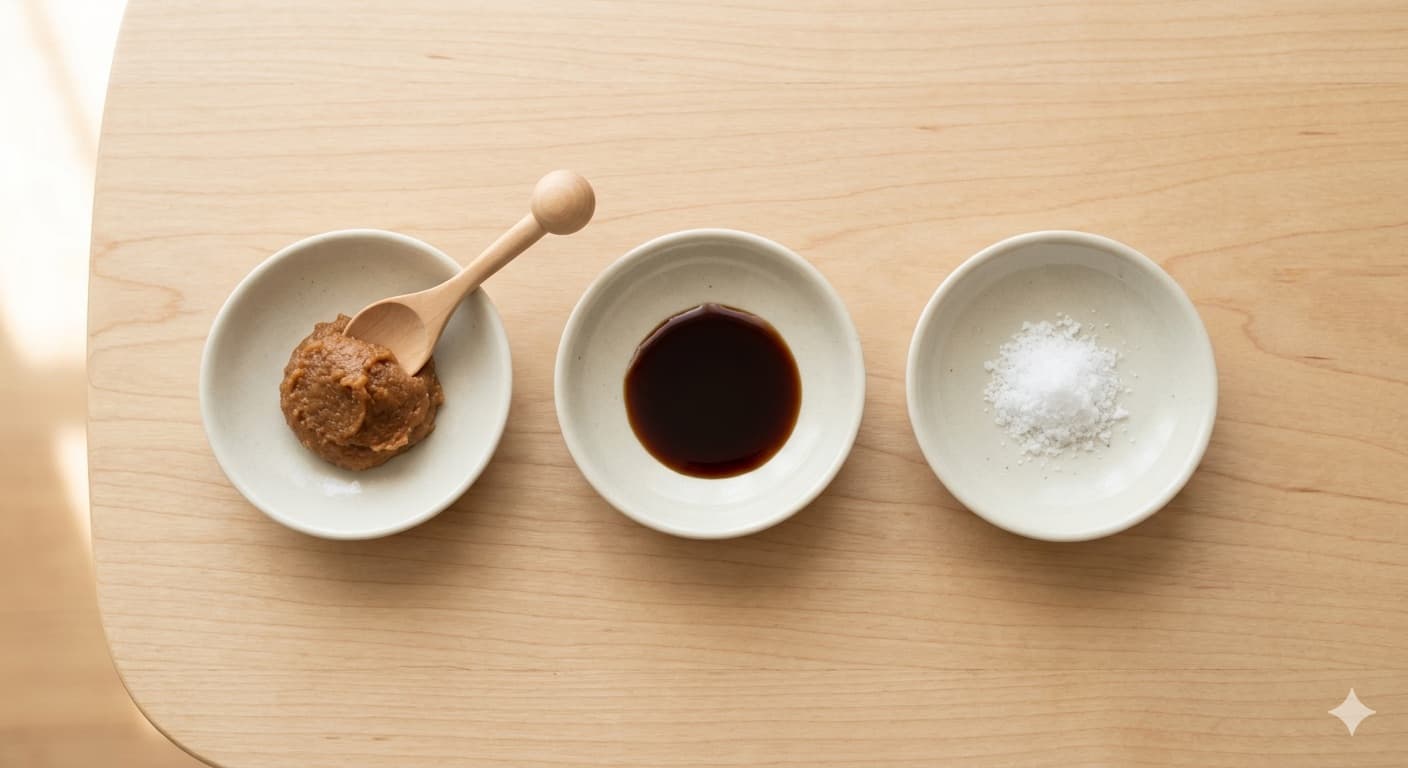
A Question I Get Asked All the Time
Japanese parents ask me this more often than almost any other weaning question: "When can I start adding miso? When can I use soy sauce?"
I understand why. Japanese cuisine is built on these seasonings. Miso soup appears on the breakfast table every morning. Soy sauce is as automatic as salt in a Western kitchen. When you cook for a baby who is slowly transitioning toward family meals, the absence of these ingredients can feel strange - even wrong.
But the timing matters, and it matters for reasons that are grounded in your baby's biology, not in tradition or overcaution.
Let me walk you through exactly what the guidelines say, why they say it, and what it looks like in practice.
Why Seasoning Timing Matters
The Developing Kidney
Babies are born with kidneys that are functional but immature. In the first six months of life, the kidneys are processing only breast milk or formula - foods that are specifically calibrated to match their capacity.
Sodium - the mineral in salt that makes salty foods taste salty - requires kidney processing to be excreted from the body. Too much sodium too early places a burden on kidneys that are not yet ready to handle it. This is not a theoretical concern. It is a physiological reality.
Japan's dietary reference values for infants set the target sodium intake for babies under 12 months at approximately 100mg per day from food. For context, a single teaspoon of regular miso contains around 400-500mg of sodium. One teaspoon of soy sauce contains around 300mg. These are adult condiments in adult quantities, and they need to be used accordingly - which is to say, very sparingly, and only from the right developmental stage.
Long-Term Taste Preferences
There is a second reason that goes beyond immediate safety: early taste experiences shape long-term food preferences.
Research consistently shows that the flavour preferences we develop in the first two years of life have a measurable influence on what we choose to eat as adults. Babies who are accustomed to strong, salty flavours from early weaning tend to develop a preference for those flavours. This is one pathway to the high rates of hypertension and cardiovascular disease associated with high-sodium diets.
Japan has one of the highest rates of hypertension in the developed world, partly attributable to a traditionally high-sodium diet. The Ministry of Health's guidance to keep baby food very low in sodium is partly a public health intervention - building palates that are comfortable with naturally flavoured food from the very beginning.
The Good News: Natural Flavour Is Enough
Here is the encouraging part: babies do not need seasoning to enjoy food. Their palates are far more sensitive than ours.
A piece of kabocha that tastes bland to an adult is richly sweet to a baby who has never tasted sugar. Plain okayu has a subtle, milky flavour that babies find genuinely satisfying. Dashi adds a depth of umami that makes vegetables more appealing without a single grain of salt.
The goal of early Japanese weaning is not to season food. It is to let babies discover and fall in love with the natural flavour of real ingredients.
Stage by Stage: What Seasonings Are Appropriate
Stage 1 (5-6 months): No Added Seasoning
At this stage, the answer is simple: no salt, no sugar, no soy sauce, no miso.
This is not a restriction so much as a design principle. Stage 1 baby food is not adult food with the seasoning removed. It is food built entirely from naturally flavoured, gently prepared ingredients.
What is appropriate at Stage 1:
- Plain okayu (smooth rice porridge)
- Single vegetable purees, unseasoned
- Small amounts of kombu dashi from around 6 months onwards (kombu dashi contains trace sodium naturally, but at the quantities used in baby food, this is negligible)
Stage 2 (7-8 months): Dashi is Your Seasoning
Stage 2 is when dashi becomes an important tool. You can now add small amounts of katsuo-kombu dashi (bonito and kelp stock) to okayu and vegetable dishes. This adds umami without salt.
Added salt, soy sauce, and miso: still not recommended.
Tiny amounts of oil can be introduced at Stage 2 - a small drizzle of sesame oil or vegetable oil in cooking, which adds flavour without sodium.
Stage 3 (9-11 months): Very Small Amounts of Miso and Soy Sauce
This is the stage where miso and soy sauce can be introduced - but in quantities that will seem absurdly small at first.
Miso: You can begin with approximately 0.5-1g of miso per meal - roughly the amount you could fit on the very tip of a small spoon. This is enough to add a gentle background flavour without contributing significant sodium.
Soy sauce: Similarly, begin with just a few drops - approximately 0.5-1ml - added to the cooking, not poured directly. Cooking the soy sauce into the food rather than adding it at the table ensures it is evenly distributed and reduces the raw pungency.
Why miso rather than other seasonings? Miso is the better first seasoning for several reasons. It contributes umami, a small amount of protein, and beneficial fermented compounds alongside its sodium. It can be added to dashi to make a very dilute, gentle miso soup - a fundamentally Japanese food that connects your baby to the family table.
Which miso to choose: Shiro miso (white miso) is lower in sodium than aka miso (red miso) and has a sweeter, milder flavour. It is the better choice for early introduction. A typical shiro miso contains around 9-11% sodium by weight, compared to 12-13% for aka miso.
Stage 4 (12-18 months): Small but Consistent Amounts
By Stage 4, your baby is moving toward participating in family meals. Seasoning levels remain significantly lower than adult food, but you have more flexibility.
A Stage 4 meal might include:
- Miso soup made with 1-1.5g of miso per serving (adult miso soup uses approximately 8-10g)
- A small amount of soy sauce used in cooking
- A few drops of rice vinegar, which is very low in sodium and adds gentle acidity
Salt from other sources - soy sauce, miso, dashi - should be counted together. The target is still well below adult sodium intake.
Dashi: The Foundation You Can Use From Stage 2
Dashi deserves its own section because it is so central to Japanese weaning and so often misunderstood.
Dashi is not a seasoning in the same category as miso or soy sauce. It is a stock - a liquid that carries umami from dried fish, kombu kelp, or other ingredients. It has a naturally savoury flavour with very little sodium at the quantities used in baby food.
The types of dashi and when to use them:
| Dashi Type | Main Ingredient | Stage | Notes |
|---|---|---|---|
| Kombu dashi | Dried kelp | Stage 1-2 | Very mild, good first dashi |
| Katsuo-kombu dashi | Bonito + kelp | Stage 2+ | Deeper umami, most versatile |
| Iriko dashi | Dried sardines | Stage 3+ | Stronger flavour, good with vegetables |
| Shiitake dashi | Dried mushrooms | Stage 2+ | Mild, good for vegetarians |
Making dashi at home takes 15-20 minutes and produces a large amount that can be frozen in ice cube trays (see the freezing guide for details). I strongly recommend making it at home rather than relying on commercial dashi packets, which almost always contain added salt and flavour enhancers.
Foods to Avoid Under 12 Months
Beyond the seasoning guidelines, two foods deserve specific mention as absolute restrictions before 12 months:
Honey (はちみつ)
Honey can contain spores of Clostridium botulinum, a bacterium that produces a dangerous toxin in the anaerobic environment of a baby's immature gut. This causes infant botulism - a serious, potentially life-threatening illness.
This restriction applies to all honey, including raw honey, manuka honey, and honey used in cooking or baking. There is no safe form of honey for babies under 12 months.
After 12 months, the gut has matured sufficiently that honey is safe.
Cow's Milk as a Drink
Cow's milk can be used in cooking from Stage 2 onwards - in small amounts in sauces or mixed into food. But it should not be given as a primary drink before 12 months.
Cow's milk has a different protein and fat profile from breast milk or formula, and contains significantly more sodium and protein than a young baby's kidneys are designed to process in large quantities. It is also low in iron, and early introduction as a main drink is associated with iron-deficiency anaemia.
From 12 months, whole cow's milk can be introduced as a drink.
A Practical Seasoning Reference by Stage
| Seasoning | Stage 1 (5-6m) | Stage 2 (7-8m) | Stage 3 (9-11m) | Stage 4 (12-18m) |
|---|---|---|---|---|
| Salt | None | None | None | Trace only |
| Soy sauce | None | None | 0.5-1ml per meal | 1-2ml per meal |
| Miso | None | None | 0.5-1g per meal | 1-1.5g per meal |
| Dashi (kombu) | Trace only | Yes | Yes | Yes |
| Dashi (katsuo) | None | Yes | Yes | Yes |
| Oil (small amount) | None | Yes | Yes | Yes |
| Rice vinegar | None | None | Small amount | Yes |
| Sugar | None | None | Trace only | Very small |
| Honey | None | None | None | From 12m onwards |
A Personal Note
I want to be honest about something I noticed in myself during my daughter's weaning: I found the no-seasoning rule harder to follow than I expected.
Not because I thought it was wrong. I know why it exists and I agree with it completely. But cooking food without adding flavour felt counterintuitive. I kept reaching for the miso container and then stopping myself.
What helped was reframing the goal. I was not making food without seasoning. I was making food that let the ingredients speak for themselves. When I made kabocha puree with a little kombu dashi, and my daughter ate it with obvious pleasure, I started to genuinely appreciate what unseasoned baby food can taste like when the ingredients are good.
It made me cook more carefully. It made me choose better vegetables. And it made me think about the fact that somewhere in her developing brain, my daughter was building a palate that would serve her for the rest of her life.
That is not a small thing.
What to Read Next
- Baby Dashi Guide - Every Type of Japanese Stock for Weaning, by Stage
- How to Freeze and Batch Cook Japanese Baby Food
- When to Start Solids - The Japanese Approach to Beginning Baby Food
Yumi is a registered dietitian (管理栄養士) and certified school nutrition teacher (栄養教諭) with 7.5 years of experience planning school lunches in Japan. She is a first-time mother currently navigating rinyushoku with her daughter, born in 2025.
Sources:
- Ministry of Health, Labour and Welfare, Japan. Enyuushoku Shien Guide (Weaning Support Guide), 2019
- Ministry of Health, Labour and Welfare, Japan. Dietary Reference Intakes for Japanese, 2020
- Fomon SJ, "Infant Feeding in the 20th Century," Journal of Nutrition, 2001
- Mennella JA, "Ontogeny of taste preferences: basic biology and implications for health," American Journal of Clinical Nutrition, 2014
- Japan Dietetic Association, "Practical Guidelines for Infant Nutrition," 2022