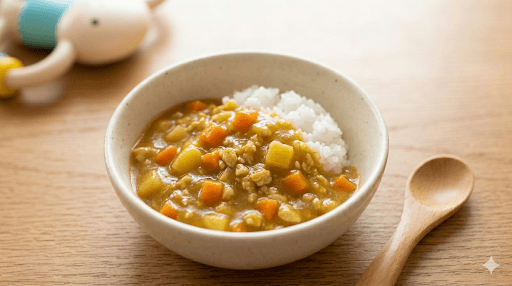
Mini Japanese Curry (Mild Baby-Friendly Version)
Allergen Information
Japanese curry (kare raisu) is consistently ranked as the most popular food among Japanese children. Unlike Indian or Thai curries, Japanese curry is mild, sweet, and thick - almost like a savory gravy. Commercial curry roux blocks contain allergens and additives unsuitable for babies, so this recipe builds the curry from scratch using baby-safe ingredients. Introducing toddlers to a mild version of Japanese curry is a milestone that many Japanese parents look forward to - it is the dish that turns a baby into a 'real eater' who can share the family dinner table.
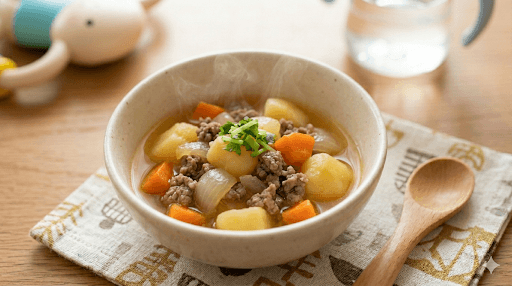
A mild, allergen-conscious version of Japan's favorite comfort food - Japanese curry. Made from scratch without commercial curry roux, using gentle spices suitable for toddlers.
Ingredients
- 50g chicken breast or thigh, diced into small pieces
- 1/4 onion, finely diced
- 1/4 carrot, finely diced
- 30g potato, peeled and finely diced
- 1 cup (240ml) dashi stock or water
- 1 teaspoon vegetable oil
- 1 teaspoon flour (for thickening)
- 1/4 teaspoon mild curry powder (no chili)
- Cooked rice for serving
Ingredient Substitutions
Can't find Japanese ingredients? Here are alternatives available at most supermarkets.
- Chicken → soft tofu cubes or ground turkey for a different protein
- Curry powder → turmeric + a tiny pinch of cumin for a milder spice blend
- Flour → cornstarch or rice flour for a gluten-free version
- Potato → sweet potato for added natural sweetness
Instructions
- 01Heat oil in a small pot over medium heat. Sauté onion until translucent.
- 02Add chicken pieces and cook until the surface turns white.
- 03Add carrot and potato, stir briefly.
- 04Sprinkle flour and curry powder over the vegetables and stir to coat evenly.
- 05Add dashi stock gradually while stirring to prevent lumps.
- 06Bring to a simmer, then reduce heat to low. Cover and cook for 20 minutes, stirring occasionally.
- 07The curry should be thick and all vegetables very soft. Mash potato slightly for extra thickness.
- 08Serve over soft-cooked rice.
Tips from a Dietitian Mom
- Use mild curry powder specifically - check that it does not contain chili pepper.
- Commercial curry roux blocks are NOT suitable for babies - they contain high sodium, allergens (wheat, soy, dairy), and additives.
- This homemade version is much lighter and gentler than restaurant curry but still has that signature Japanese curry flavor.
- Make extra and freeze - Japanese curry actually improves in flavor after a day, and it freezes beautifully.
Storage & Freezing
Refrigerate for up to 48 hours (tastes even better the next day). Freeze for up to 1 month. Store rice separately from curry for best texture.
Master the Basics
Nutrition Facts
Per serving (approximate)
Frequently Asked Questions
- Can I use store-bought curry roux for babies?
- No - commercial curry roux blocks contain high levels of sodium, fats, wheat, dairy, and various additives that are not suitable for babies under 18 months. Always make baby curry from scratch with controlled ingredients.
- When can toddlers eat regular Japanese curry?
- Most Japanese parents begin offering mild commercial curry (labeled for children, like 'kodomo curry') from around 18 months to 2 years, then gradually transition to regular family curry around age 3-4.
- Is curry powder safe for babies?
- Mild curry powder (without chili) is generally fine from 12 months in small amounts. The spices in curry powder - turmeric, coriander, cumin - are not harmful. Start with a very small amount and increase gradually.
Free Baby Food Starter Guide
Get our free PDF guide to starting solids the Japanese way, plus weekly recipes and nutrition tips for your little one.