
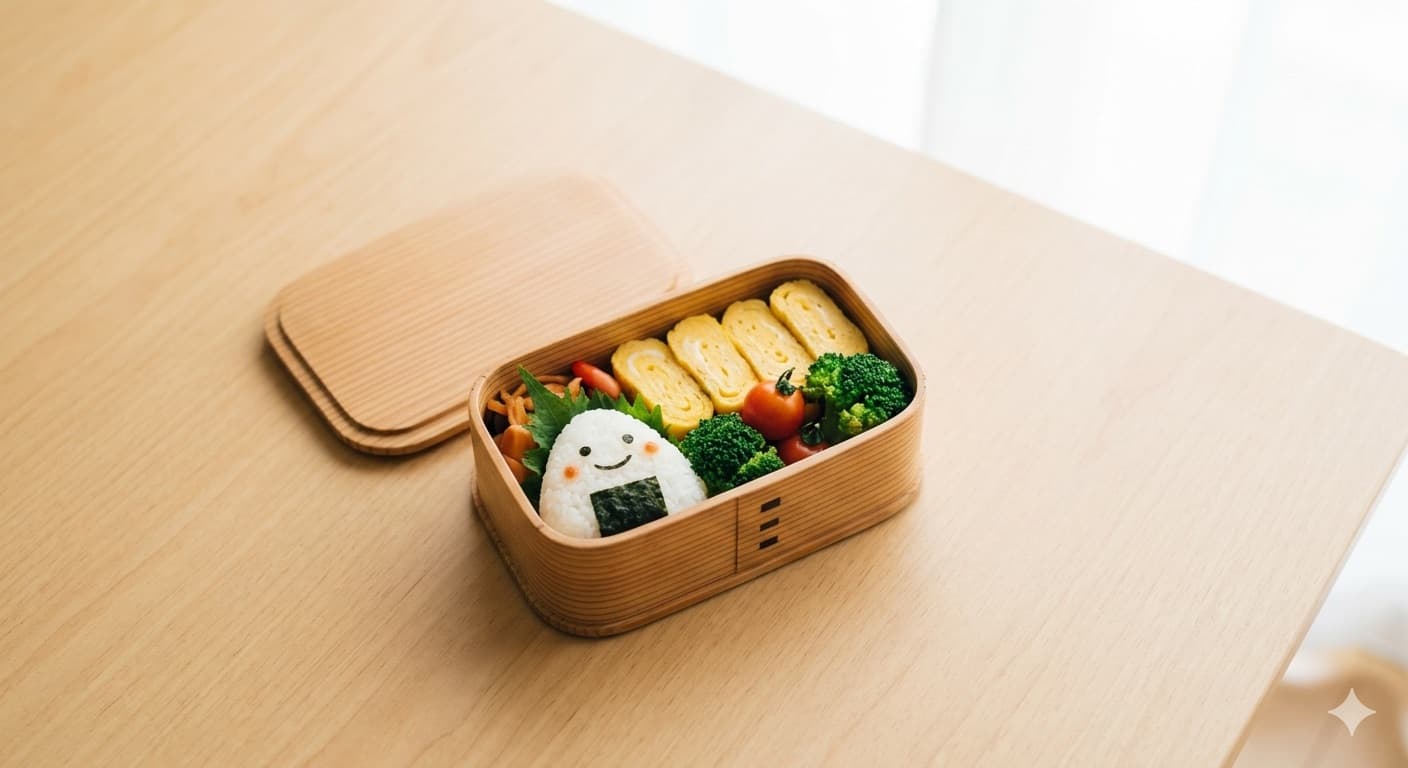
The Lunch That Says "I Love You"
In Japan, a bento box is never just food.
When a Japanese parent wakes up early to pack their child's lunch - cutting vegetables into shapes, arranging colours carefully, tucking in a small note - they are doing something that extends well beyond nutrition. They are communicating something that Japanese culture considers too important to leave unsaid.
I thought about you this morning. I made this for you. You matter.
I grew up receiving bentos made by my mother. I later made them as a nutrition teacher for school events when the standard kyushoku wasn't available. And now I pack them for my own children. With each generation, the same gesture repeats itself, carrying the same quiet message.
Understanding the bento means understanding something central to how Japan thinks about food, care, and the relationship between the two.
A Brief History of the Bento
The bento has existed in Japan for over 1,200 years.
Its earliest forms were simple - cooked rice shaped into balls (onigiri) and carried by travellers, farmers, and warriors. By the Edo period (1603-1868), the bento had evolved into an elaborate cultural object. The lacquered bento boxes of the aristocracy became works of art. Train station bento (ekiben) developed into a regional food tradition with its own dedicated guidebooks and fanbase.
Today, the bento appears in virtually every context of Japanese daily life: school lunch, office lunch, picnics, sports days, festivals, and travel. There are bento cooking classes, bento Instagram communities, bento competitions, and entire shops devoted exclusively to bento equipment.
The form has changed. The function - a carefully prepared, portable, complete meal - has not.
The Bento as Nutritional Framework
What makes a bento nutritious isn't the ingredients alone. It's the container.
A traditional bento box is divided into compartments, and these compartments carry implicit expectations about what goes where. The largest space is for rice - the anchor carbohydrate. The remaining space is divided between a main protein dish and several small sides, usually vegetables prepared in different ways.
This is ichiju sansai in portable form.
The physical structure of the box guides the balance of the meal. If the rice compartment is large, you fill it with rice - not with extra protein or snacks. If there are three small compartment spaces, you fill them with three different things. The result is variety and portion awareness built into the container itself.
From a nutritional standpoint, this is significant. Research on plate and container size shows that the structure of the vessel we eat from strongly influences how much and what we eat. The bento box is, in effect, a nutritional architecture.
What Children Learn From Bento
The bento is one of the earliest practical expressions of shokuiku - Japan's food education philosophy - in a child's life.
Visual variety. A well-made bento uses colour deliberately: orange carrots, green edamame, yellow egg, white rice, red tomato. Children learn from a young age that a meal should look varied - that different colours signal different nutrients, and that a colourful box is a sign of a good lunch.
Portion awareness. Bento boxes teach children to understand appropriate amounts - not through rules or calorie counts, but through the concrete experience of a box that is meant to be full, but not overflowing. This connects to the broader Japanese concept of hara hachi bu: eating until about 80% full, a practice that has been associated with lower rates of obesity and metabolic disease.
Gratitude. The bento visibly represents someone's effort. Even young children understand that the food in the box didn't appear by itself. The Japanese practice of saying "itadakimasu" before eating takes on particular meaning when the meal was made specifically for you, by someone who thought about what you like.
Food familiarity. Repeated exposure to the same foods, presented in small portions within a structured container, is one of the most effective ways to build a broad palate in young children. The bento is a daily opportunity for low-pressure exposure to variety.
The Kyaraben Phenomenon
No discussion of bento culture is complete without mentioning kyaraben - character bento.
Kyaraben are bentos in which the food is shaped and arranged to resemble cartoon characters, animals, landscapes, or seasonal themes. Rice formed into a bear's face. Nori cut into eyes and a nose. Sausages shaped like flowers. Egg sheets sculpted into petals.
The popularity of kyaraben is sometimes misunderstood outside Japan as simply a craft hobby. But its function in food education is real: children who are reluctant to eat certain foods will sometimes eat them when those foods are presented as part of a character they love.
I used this principle regularly as a nutrition teacher. A child who refused to eat broccoli would occasionally eat "broccoli trees" arranged around a rice-ball character. The food was identical. The presentation changed the experience.
Kyaraben takes this to its logical extreme - but the principle behind it is the same one that underlies all good food education for children. Presentation matters. Playfulness is a legitimate nutritional tool.
Bento for Babies and Toddlers
The transition from puree to finger food is a natural moment to introduce the bento concept.
A toddler bento doesn't need to be elaborate. What it needs is:
- A rice or grain base - soft rice, soft wholegrain bread, or mild rice porridge shaped into a small ball
- One protein - soft scrambled egg, flaked fish, or well-cooked tofu
- Two or three small vegetable portions - steamed broccoli florets, carrot sticks cooked until soft, sliced avocado
The compartments of even a simple bento box will naturally guide you toward this balance.
For babies still in the later stages of weaning (around 9-12 months), a "bento moment" at the table - a divided plate with small portions of three or four foods - provides the same psychological benefit: variety presented in an organised, clear way, with each food visible and separate.
This matters more than it sounds. Children who can see what is in front of them, food by food, are more likely to try each item. Mixed dishes - everything blended together - make variety invisible.
Starting a Bento Practice at Home
You don't need special equipment, elaborate techniques, or hours of preparation.
Start with the right box. A simple divided bento box with two or three compartments is enough. The compartments do the work of guiding balance. Avoid boxes that are too large - the size of the box should match one meal for the child's age.
Use the colour rule. Aim for at least three different colours in the box. This is not a rule about appearance - it is a rough shortcut to nutritional diversity. Different coloured vegetables contain different phytonutrients.
Prepare components in advance. Japanese home cooks often make small portions of cooked vegetable sides (called okazu) in advance and refrigerate them. Mashed sweet potato, stewed kabocha, blanched spinach with sesame - these keep for two to three days and can be pulled out to fill bento compartments quickly in the morning.
Let the child participate. Once a child is old enough, involving them in packing their own bento - even just placing the rice or choosing which vegetable goes in which compartment - dramatically increases the likelihood that they will eat what's inside.
The Care Embedded in Every Box
In Japan, the bento is sometimes called ai-ben - love lunch. The term is informal, but it captures something real about what the bento represents.
Food made for a specific person, with that person's preferences in mind, presented with care - this is a different experience from food that is simply available. Japanese food culture has preserved this distinction with unusual clarity.
Whether you pack a bento for a child every day or only occasionally, the practice carries the same meaning: I made this for you. I thought about you. Here is what I know you like.
That is not a small thing. In the life of a child learning their relationship with food, it may be one of the most important things of all.
Related Articles
- Ichiju Sansai: The Japanese Meal Formula That Makes Nutrition Simple
- What Is Shokuiku? Japan's Food Education Philosophy Explained
- What Is Kyushoku? A Japanese School Nutrition Teacher Explains
Yumi is a registered dietitian and former school nutrition teacher. She has packed bentos for children ranging from toddlers to school-age kids, and continues to do so for her own family.
Sources:
- Ashkenazi M. and Jacob J., "The Essence of Japanese Cuisine," University of Pennsylvania Press, 2000
- Wansink B. et al., "From mindless eating to mindlessly eating better," Physiology & Behavior, 2010
- Tatemi Y. et al., "Lunchbox contents and dietary behaviour in Japanese preschool children," Journal of Nutritional Science and Vitaminology, 2018
- MEXT, "Survey on the Status of School Lunches in Japan," 2023
- Birch L. and Fisher J., "Development of eating behaviors among children and adolescents," Pediatrics, 1998