
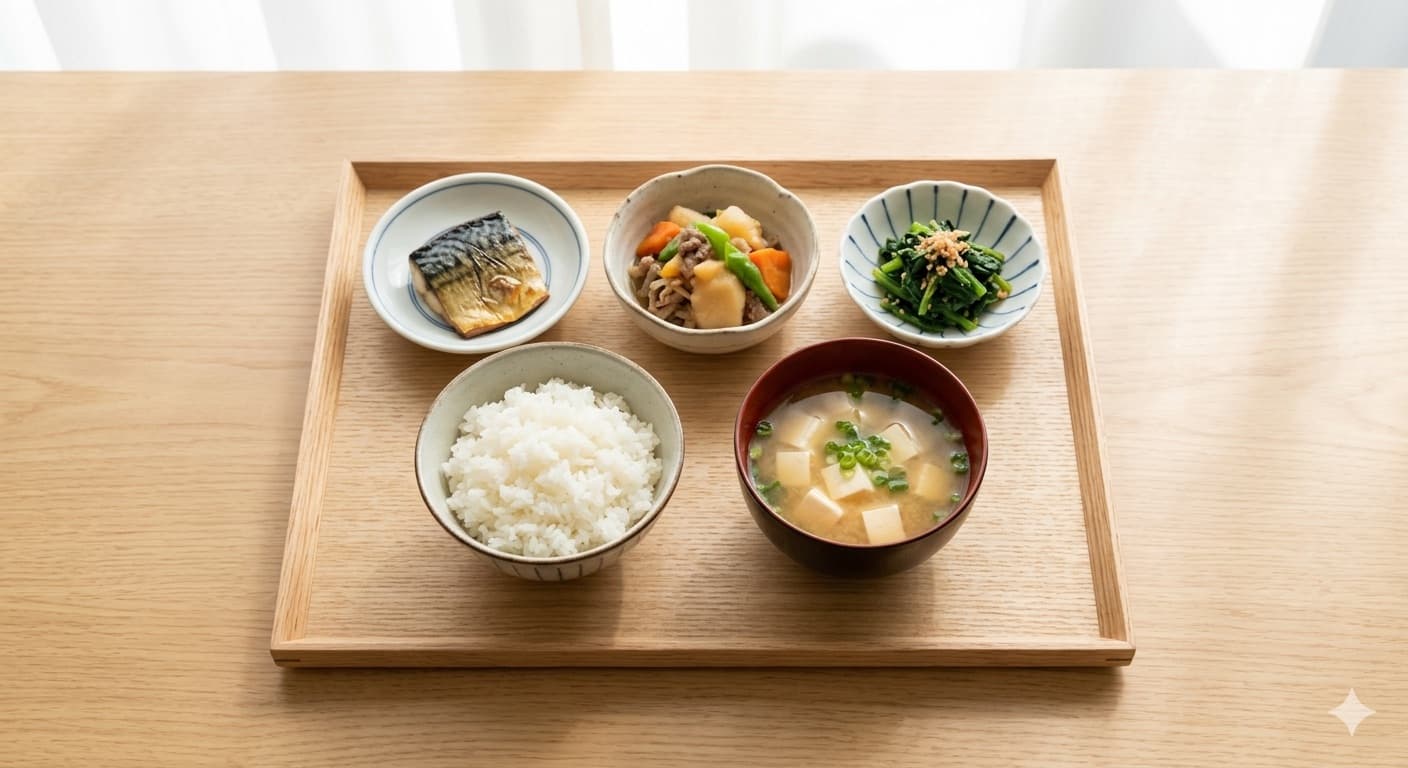
The Formula Behind Japan's Healthiest Meals
When researchers and journalists try to explain why Japan has one of the lowest rates of lifestyle disease in the world, they often point to ingredients - green tea, fish, fermented foods, seaweed. These things matter. But they miss something more fundamental.
Japan doesn't just eat different foods. Japan structures meals differently.
The framework is called ichiju sansai - literally "one soup, three dishes." It is an organising principle for the Japanese meal that has existed for over a thousand years, and it remains the foundation of everyday eating today - in homes, in school lunches, and in traditional restaurants.
As a registered dietitian who spent five and a half years planning school lunches, ichiju sansai was not just cultural background for me. It was a working tool. Every menu I designed was built on this structure.
What Ichiju Sansai Actually Means
The formula is simple:
- Gohan (ご飯) - a bowl of steamed rice, the anchor of every Japanese meal
- Ichiju (一汁) - one soup, almost always miso soup with seasonal ingredients
- Sansai (三菜) - three dishes:
- One main dish (protein - fish, tofu, meat, egg)
- One side dish (cooked vegetables)
- One side dish (pickled or raw vegetables, or another vegetable preparation)
That's it. One bowl of rice, one soup, three small dishes. The entire Japanese meal tradition fits into this architecture.
What makes it remarkable is what it produces automatically: variety of ingredients, balance of macronutrients, distribution of cooking methods, and a natural portion structure that prevents any single food from dominating.
You don't have to think about getting enough protein, or enough fibre, or enough vegetables. The structure does it for you.
Why It Works Nutritionally
From a dietitian's perspective, ichiju sansai is elegant because it encodes good nutrition into the form of the meal itself - without requiring anyone to count grams or calculate percentages.
Carbohydrates come from the rice - a slow-digesting complex carbohydrate that provides sustained energy.
Protein comes from the main dish - fish, chicken, tofu, eggs, or legumes - rotating through different sources across the week naturally provides a broad amino acid profile.
Vegetables appear in at least two of the three side dishes, often prepared in different ways: one stewed, one blanched, one pickled or fresh. Different preparation methods preserve different vitamins and create different textures.
Fermentation is built into the meal through miso soup. Fermented foods feed the gut microbiome - a connection that Japanese food culture made intuitively centuries before the microbiome was understood scientifically.
Mineral density is high because of the dashi broth that forms the base of miso soup - and often flavours the cooked vegetable sides too. Dashi made from kombu seaweed provides iodine, glutamates, and trace minerals at levels that are genuinely difficult to match from other sources.
Ichiju Sansai and Baby Food
When I started thinking about how Japanese weaning works, I realised that ichiju sansai doesn't just apply to adult meals - it's the model that baby food naturally grows toward.
Okayu (rice porridge) is the gateway. Rice in its simplest, most digestible form - the gohan of the earliest stage of eating.
Dashi appears almost immediately after - the backbone of Japanese baby food, added to vegetables and porridge to provide depth of flavour without salt or sugar.
From there, the three-sides principle guides what comes next: a protein food, a cooked vegetable, and another vegetable prepared differently. Not all at once in the early weeks - but progressively, as the baby moves through the stages.
By the time a Japanese baby reaches the Complete Stage (12-18 months), they are eating a simplified version of ichiju sansai at every meal. The structure has already been established. What changes is only the texture and portion size.
This is not accidental. Japanese baby food is ichiju sansai at its earliest, most foundational expression.
How It Differs from Western Meal Thinking
Western meal planning tends to organise around a main dish. You decide what the protein is, and everything else is built around it. The protein dominates; the vegetables play supporting roles.
In ichiju sansai, no single dish dominates. The rice is the anchor - present at every meal, in every season - and the three sides rotate. Protein is one element among equals, not the centrepiece.
This has practical consequences.
When protein is the organising principle of the meal, vegetable variety tends to be limited. You make chicken, you add a side salad and some roasted vegetables. When the meal structure itself demands multiple vegetable preparations, you end up with far greater diversity over the course of a week.
Research consistently shows that dietary diversity - the number of different food groups eaten regularly - is one of the strongest predictors of nutritional adequacy. Ichiju sansai produces dietary diversity structurally. You don't have to plan for it. It just happens.
Applying Ichiju Sansai Outside Japan
You don't need a Japanese kitchen or Japanese ingredients to use this framework. The principle is universal.
Replace rice with any whole grain that anchors your family's diet - brown rice, millet, quinoa, wholegrain bread. The key is a consistent, neutral carbohydrate base.
Keep the soup. Miso soup is ideal - deeply nutritious and takes five minutes to make. But any broth-based soup with vegetables and tofu or egg works on the same principle.
Think in threes for the sides. One protein dish. Two vegetable dishes, prepared differently. Even "protein plus two vegetables" is a powerful simplification that most families can apply immediately.
Rotate, don't repeat. The real power of ichiju sansai is that the structure stays the same while the ingredients change with the seasons and what's available. Boredom is impossible when the contents are always shifting inside the same container.
For families introducing babies to solid food, this framework is especially useful. You're not inventing a new approach to every meal - you're working within a structure that was designed, over centuries, to produce exactly what you want: variety, balance, and meals that feel complete.
The Lesson From a Thousand Years of Eating
Ichiju sansai is not a modern invention. It emerged from Buddhist temple cuisine and the cooking traditions of the Japanese aristocracy, and spread through the general population over many centuries. What the Japanese discovered through practice and culture, nutritional science has since confirmed through research.
Structure matters. How a meal is organised shapes what gets eaten - and what gets left out. The right structure makes good nutrition the default, not the exception.
That is the real lesson of ichiju sansai. Not just what Japan eats, but how Japan thinks about what a meal should be.
Related Articles
- What Is Shokuiku? Japan's Food Education Philosophy Explained
- What Is Kyushoku? A Japanese School Nutrition Teacher Explains
- The Ultimate Guide to Baby Dashi Stock
Yumi is a registered dietitian and certified school nutrition teacher. She planned school lunches based on the ichiju sansai framework for five and a half years at a Japanese elementary school.
Sources:
- Mori H., "Traditional Japanese food culture and its transformation," Appetite, 2017
- Tsuji E. et al., "Dietary diversity and nutritional status in Japanese adults," Nutrients, 2019
- UNESCO, "Washoku, traditional dietary cultures of the Japanese," Intangible Cultural Heritage, 2013
- MHLW (Ministry of Health, Labour and Welfare), "Dietary Reference Intakes for Japanese," 2020
- Iso H. et al., "The relationship between green tea and total caffeine intake and risk for self-reported type 2 diabetes," Annals of Internal Medicine, 2006