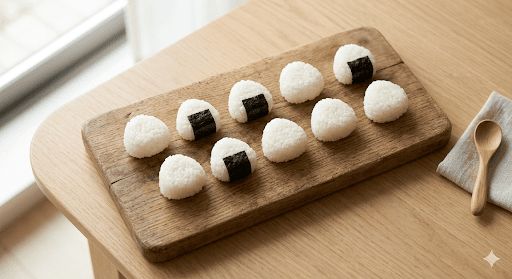
Hand-Sized Onigiri (Baby Rice Balls)
Allergen Information
Onigiri is one of Japan's most essential foods, and making tiny ones for babies is a rite of passage for Japanese parents. Around 9-11 months, when babies develop their pincer grasp and want to feed themselves, mini onigiri become a daily staple. Japanese mothers shape them into tiny balls or flattened discs that fit perfectly in baby hands. Unlike adult onigiri, baby versions use no salt and are made with slightly softer, stickier rice. Watching a baby successfully grab and eat their first onigiri is a celebrated moment in many Japanese families.
Tiny, soft rice balls designed for baby hands - the perfect self-feeding food. Japanese babies love holding and eating these little onigiri, making mealtime fun and independent.
Ingredients
- 1 cup cooked Japanese short-grain rice (soft-cooked, slightly more water than normal)
- Optional fillings: 1 teaspoon shirasu (desalted), 1 teaspoon mashed pumpkin, 1 teaspoon finely chopped nori
Ingredient Substitutions
Can't find Japanese ingredients? Here are alternatives available at most supermarkets.
- Japanese short-grain rice → Calrose or any sushi rice
- Shirasu → flaked canned tuna (in water, low sodium) or finely mashed avocado
- Nori → omit if unavailable; the rice balls work fine without it
Instructions
- 01Cook rice with slightly more water than usual so it is softer and stickier.
- 02Wet your hands with water to prevent sticking.
- 03Take about 1 tablespoon of rice and gently form into a small ball or flat disc.
- 04If adding fillings, place a tiny amount in the center and wrap rice around it.
- 05Make each onigiri small enough for baby to hold in one hand - about 3cm diameter.
- 06Optionally wrap with a thin strip of nori for extra grip and nutrition.
- 07Serve at room temperature. Place a few on baby's tray and let them self-feed.
Tips from a Dietitian Mom
- Don't pack the rice too tightly - baby onigiri should be soft and slightly loose so they dissolve easily when chewed.
- Wet your hands between each onigiri to prevent the rice from sticking to your palms.
- Nori strips help baby grip the rice ball and add iron and minerals.
- This is the perfect food for on-the-go snacking and introducing self-feeding confidence.
Storage & Freezing
Best eaten within 2 hours at room temperature. Can be wrapped in plastic wrap and refrigerated for up to 12 hours - microwave briefly to re-soften before serving.
Nutrition Facts
Per serving (approximate)
Frequently Asked Questions
- What size should baby onigiri be?
- About 3cm in diameter - roughly the size of a walnut. This is the perfect size for a 9-11 month old to grip and bring to their mouth. You can make them slightly larger as baby grows.
- My baby squishes the onigiri instead of eating it. Is that normal?
- Completely normal! Squishing, smearing, and playing with food is part of the learning process. Babies are developing their motor skills and exploring textures. Keep offering - they will eat more over time.
- Can I add salt like regular onigiri?
- No - baby onigiri should be made without any salt. Babies under 1 year should have minimal sodium. The natural flavor of good-quality Japanese rice is enough.
Free Baby Food Starter Guide
Get our free PDF guide to starting solids the Japanese way, plus weekly recipes and nutrition tips for your little one.